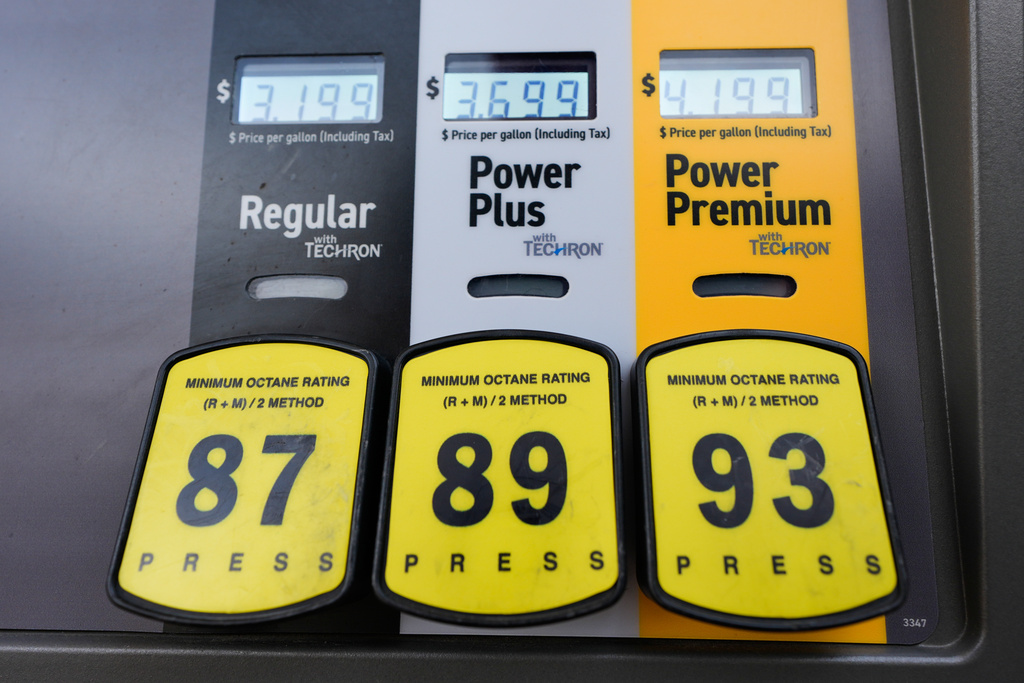
***Update: $3.478 per gallon (AAA U.S. national regular gasoline average)
NEW YORK (AP) — Stock markets worldwide are sinking on worries about whether the global economy can withstand spiking prices for oil, which briefly got to nearly $120 per barrel on Monday. But for as scary as the moves have been, they remain twitchy and quick to reverse amid all the uncertainty caused by the war with Iran.
The S&P 500 fell 0.5% after dropping as much as 1.5% in the morning. The Dow Jones Industrial Average was down 365 points, or 0.8%, as of 11:30 a.m. Eastern time, and the Nasdaq composite was 0.1% lower. That followed worse losses in European and Asian stock markets.
Since the war with Iran began with attacks by the United States and Israel, the central worry for financial markets has been how high oil prices will go because of it and how long they will stay there. Early Monday, the price for a barrel of Brent crude, the international standard, briefly touched $119.50. It hasn’t been that expensive since the summer after Russia invaded Ukraine in 2022, another military conflict that likewise raised the risk for blockages in the global flow of oil.
If oil prices stay very high for very long, households’ budgets already stretched by high inflation could break under the pressure. Companies, meanwhile, would see their own bills jump for fuel and to stock items on their store shelves or in their data warehouses. It all raises the possibility of a worst-case scenario for the global economy “stagflation,” where growth stagnates and inflation remains high.
To be sure, oil prices quickly pared their huge gains Monday. A barrel of Brent crude pulled back to $99.26, though that’s still up 7.1% from Friday.
A barrel of benchmark U.S. crude, meanwhile, rose 5.4% to $95.81 after briefly spiking as high as $119.48.
The U.S. stock market has a history of bouncing back relatively quickly from past military conflicts, such as Russia’s invasion of Ukraine in 2022, as long as oil prices don’t stay too high for too long. And even with all the recent swings in the market, the S&P 500 index that sits at the heart of many 401(k) accounts is still within 4% of its record set in January.
(background)
Iran launched more attacks on Israel and Gulf countries Monday, hours after Iranian state TV said Ayatollah Mojtaba Khamenei, son of the country’s late supreme leader and long considered a contender, had been named his successor.
Iran’s powerful paramilitary Revolutionary Guard answers to the supreme leader and the younger Khamenei will have a central say in the war strategy.
Oil prices skyrocketed Monday, leading to more worries that higher energy costs will fuel inflation and lead to less spending by U.S. consumers, the main engine of the economy. Tokyo’s benchmark Nikkei 225 index plunged as much as 7% in early Monday trading, while other Asian markets also tumbled.
Saudi Arabia sharpened its warnings to Iran, telling Tehran Monday it would be the “biggest loser” if it continues to attack Arab states. The Saudi statement came after a new drone attack apparently targeted its massive Shaybah oil field.
CHICAGO (AP) — Oil prices have eclipsed $100 per barrel for the first time in more than three and a half years as the Iran war hinders production and shipping in the Middle East.
The price for a barrel of Brent crude, the international standard, was at $101.19 shortly after trading resumed on the Chicago Mercantile Exchange, up 9.2% from its settlement price of $92.69 Friday.
West Texas Intermediate, the light, sweet crude oil produced in the United States, was selling for about $107.06 a barrel. That’s 16.2% higher than its Friday settlement price of $90.90.
Both could rise or fall as market trading continues.
The increases followed U.S. crude prices jumping by 36% and Brent crude prices rising 28% last week. Oil prices have surged as the war, now in its second week, ensnared countries and places that are critical to the production and movement of oil and gas from the Persian Gulf.
Roughly 15 million barrels of crude oil — about 20% of the world’s oil — typically are shipped every day through the Strait of Hormuz, according to independent research firm Rystad Energy. The threat of Iranian missile and drone attacks has all but stopped tankers from traveling through the strait, which is bordered in the north by Iran, carry oil and gas from Saudi Arabia, Kuwait, Iraq, Qatar, Bahrain, the United Arab Emirates and Iran.
Iraq, Kuwait and the UAE have cut their oil production as storage tanks fill due to the reduced ability to export crude. Iran, Israel and the United States also have attacked oil and gas facilities since the war started, exacerbating supply concerns.
The last time U.S. crude futures traded above $100 per barrel was June 30, 2022, when the price reached $105.76. For Brent, it was July 29, 2022, when the price hit $104 per barrel.
The global surge in oil prices since Israel and the U.S. attacked Iran on March 1 has rattled financial markets, sparking worries that higher energy costs will fuel inflation and lead to less spending by U.S. consumers, the main engine of the economy.
In the U.S., a gallon of regular gasoline rose to $3.45 on Sunday, about 47 cents more than a week earlier, according to AAA motor club. Diesel was selling for about $4.60 a gallon, a weekly increase of about 83 cents.
The price of natural gas has also climbed, though not as much as oil. It rose about 11% last week and ended Friday at $3.19 per 1,000 cubic feet.
If oil prices stay above $100 per barrel, some analysts and investors say it could be too much for the global economy to withstand.
Over the weekend, Israel’s military struck oil depots in Tehran and four oil storage tankers and a petroleum transfer terminal.
Mohammad Bagher Qalibaf, the speaker of Iran’s parliament, said the war’s impact on the oil industry would spiral, warning it soon could become harder to produce and sell oil.
Iran exports roughly 1.6 million barrels of oil a day, mostly to China, which may need to look elsewhere for supply if Iran’s exports are disrupted, another factor that could increase energy prices.